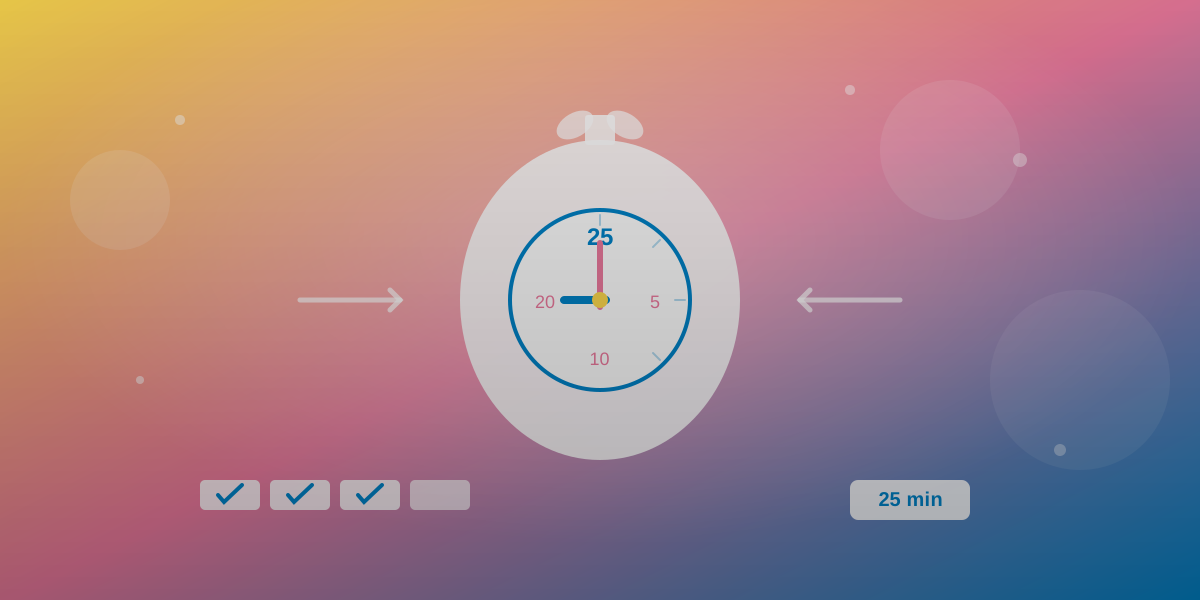
In 1987, a university student in Italy was struggling to focus on his studies. Overwhelmed by distractions and unable to concentrate for more than a few minutes at a time, Francesco Cirillo grabbed a kitchen timer shaped like a tomato and made a deal with himself: focus for just two minutes. That simple act with a tomato timer—or “pomodoro” in Italian—would eventually become one of the most effective productivity techniques ever created.
Nearly four decades later, the Pomodoro Technique remains remarkably relevant. But here’s what’s surprising: it’s not just about time management. It’s about training your brain to embrace single-task focus in a world designed to fragment your attention.
What is the Pomodoro Technique?
The Pomodoro Technique is a time management method that breaks work into focused intervals, traditionally 25 minutes long, separated by short breaks. The basic framework is elegantly simple:
- Choose one task to focus on
- Set a timer for 25 minutes and work with full concentration
- Take a 5-minute break when the timer rings
- Repeat the process
- After 4 pomodoros, take a longer break of 15-30 minutes
The genius of this technique isn’t in the specific numbers—it’s in the principle of dedicated focus followed by intentional rest. By committing to just one task for a defined period, you’re practicing what we at ThatOneThing believe is the foundation of real productivity: doing one thing well beats doing many things poorly.
The Science Behind Why Pomodoros Work
You might wonder: why 25 minutes? Is there something magical about that specific duration?
Research in cognitive psychology reveals that the Pomodoro Technique aligns perfectly with how our brains actually work:
Attention Spans Are Limited: Studies show that the average person can maintain focused attention for 20-40 minutes before mental fatigue sets in. The 25-minute pomodoro sits in the sweet spot of sustained concentration without cognitive overload.
The Power of Breaks: A study from the University of Illinois found that brief diversions from a task can dramatically improve one’s ability to focus on that task for prolonged periods. The regular breaks in the Pomodoro Technique aren’t a reward—they’re a neurological necessity that prevents attention fatigue.
Task-Switching Costs: Every time you switch between tasks, your brain needs time to reorient. Research by Sophie Leroy at the University of Minnesota found this “attention residue” can reduce performance by up to 40%. By dedicating each pomodoro to a single task, you eliminate these costly mental transitions.
Particularly Effective for ADHD Minds: For individuals with ADHD, the Pomodoro Technique offers several neurological advantages. The time pressure creates a sense of urgency that increases dopamine production, while the frequent breaks provide the novelty and movement that ADHD brains crave. The clear structure reduces decision fatigue and the external timer serves as an accountability partner.
The research is clear: our brains aren’t designed for marathon focus sessions. They’re designed for intense bursts of concentration followed by recovery. The Pomodoro Technique simply codifies this natural rhythm.
How to Use the Pomodoro Technique with ThatOneThing
Ready to implement the Pomodoro Technique? Here’s a step-by-step guide that integrates seamlessly with ThatOneThing’s single-task focus philosophy:
Step 1: Identify Your One Thing
Before you start any pomodoro, you need clarity. What’s the one task that deserves your next 25 minutes of focus?
This is where ThatOneThing shines. Instead of staring at an overwhelming to-do list, open the app and identify your most important task for this work session. Make it specific: not “work on project” but “write introduction section for client proposal.”
The key principle: One pomodoro = one clearly defined task or task component.
Step 2: Eliminate Distractions
Put your phone in Do Not Disturb mode—except for ThatOneThing’s gentle reminders. Close unnecessary browser tabs. Tell colleagues you’ll be unavailable for 25 minutes. Create a distraction-free environment where your chosen task is the only thing that exists.
With ThatOneThing’s home screen widget displaying your current focus, you have a constant visual reminder of what you’re committed to. Every time you glance at your phone, you see your one thing—not a dozen competing priorities.
Step 3: Start Your Pomodoro Timer
Set your timer for 25 minutes and commit fully. This is sacred time dedicated entirely to your one task. No email checking, no “quick” social media scrolls, no multitasking.
While traditional pomodoro practitioners use kitchen timers, ThatOneThing users can set reminders that align with their focus sessions. The app’s philosophy of single-task visibility perfectly complements the pomodoro’s demand for undivided attention.
Step 4: Work With Complete Focus
For the next 25 minutes, your job is simple: make progress on your one thing. Not perfect progress—just progress. If you get stuck, keep working on related aspects of the task rather than switching to something else.
Pro tip: Keep a “distraction list” nearby. When random thoughts or tasks pop into your head during a pomodoro (and they will), jot them down quickly and return to your focus task. You can address these items during your break or in a future pomodoro.
Step 5: Take Your Break Seriously
When the timer rings, stop. Even if you’re in the flow. Especially if you’re in the flow.
The break isn’t optional—it’s when your brain consolidates what you just learned and prepares for the next session. Stand up, stretch, grab water, look out a window. Don’t check email or dive into another task. This is recovery time.
ThatOneThing’s gentle notification system can remind you when it’s time to take your break and when to start your next pomodoro, creating a sustainable rhythm of focus and rest.
Step 6: Track Your Progress
After each pomodoro, mark it completed. Many people use a simple tally system, but ThatOneThing users have something better: the satisfaction of seeing their one important task move toward completion, one focused session at a time.
Tracking your pomodoros serves two purposes: it provides motivational feedback (you completed 6 focused work sessions today) and helps you estimate future work (that report typically takes 4 pomodoros to complete).
Common Pomodoro Challenges and Solutions
Like any productivity technique, the Pomodoro Technique comes with challenges. Here’s how to overcome the most common obstacles:
Challenge 1: “I get interrupted constantly”
The reality: Interruptions are inevitable, especially in collaborative work environments.
The solution: Distinguish between internal and external interruptions. For internal interruptions (your own wandering thoughts), use the “distraction list” technique mentioned earlier. For external interruptions, practice the “inform, negotiate, schedule, call back” approach: let the interrupter know you’re in a focus session, negotiate a time to address their need, schedule it, and return to your pomodoro. Most interruptions can wait 15 minutes.
If you work in a high-interruption environment, consider using visible signals—headphones, a small sign, or a status indicator—to show when you’re in a pomodoro.
Challenge 2: “25 minutes feels too short (or too long)”
The reality: Different tasks and different brains have different optimal focus durations.
The solution: The 25-minute pomodoro is a starting point, not a law. Experiment with variations:
- 52/17 method: Work for 52 minutes, break for 17 (based on research from the Draugiem Group on top performers)
- 90-minute ultradian rhythms: Align with your body’s natural focus cycles with 90-minute deep work sessions
- 15-minute mini-pomodoros: Perfect for ADHD minds or particularly challenging tasks where 25 minutes feels overwhelming
The principle remains the same: dedicated focus on one task, followed by intentional rest. ThatOneThing’s flexible approach to task focus supports whatever timing works best for your brain.
Challenge 3: “I can’t stop in the middle when I’m in flow”
The reality: Breaking flow feels counterproductive.
The solution: This is actually a feature, not a bug. The Pomodoro Technique’s forced breaks prevent burnout and maintain sustainable productivity. That said, if you’re truly in deep flow and making exceptional progress, it’s okay to extend a pomodoro to finish a thought or complete a section. Just make sure your next break is proportionally longer.
Remember: tomorrow’s productivity matters as much as today’s. Burning out in a marathon work session helps no one.
Challenge 4: “I don’t know what to do during breaks”
The reality: We’re so accustomed to constant stimulation that intentional rest feels uncomfortable.
The solution: Breaks should be truly restorative. Here’s what works:
Good break activities:
- Walking, even just around your room
- Stretching or light exercise
- Looking at distant objects to rest your eyes
- Drinking water or making tea
- Brief meditation or breathing exercises
- Stepping outside for fresh air
Avoid during breaks:
- Social media (it’s not restful; it’s stimulating)
- Email (it will pull your attention to other tasks)
- Anything with a screen if possible
- Starting another work task
Challenge 5: “My tasks don’t fit neatly into 25-minute chunks”
The reality: Real work is messy. Some tasks take 2 hours, some take 8 minutes.
The solution: Break large tasks into pomodoro-sized components. Instead of “write article,” think “outline main sections” (1 pomodoro), “write introduction” (1 pomodoro), “draft section one” (2 pomodoros), etc.
For small tasks, batch several together in one pomodoro: “respond to emails” might include 5-7 individual emails completed in a single focused session.
This is where ThatOneThing’s focus on identifying your most important task becomes crucial. Even if that task will take 8 pomodoros to complete, each individual session focuses on making meaningful progress on that one thing.
Customizing the Pomodoro Technique for Maximum Impact
Once you’ve mastered the basic technique, consider these variations to optimize for your specific needs:
For Deep Creative Work
Creative tasks often require longer warm-up periods. Try a 50/10 split: 50 minutes of focused work, 10-minute breaks. This gives you enough time to get into creative flow while still maintaining regular recovery intervals.
For Analytical or Learning Tasks
When learning new material or solving complex problems, try 25/5 with active recall: Use your 5-minute break to mentally review what you just learned or worked on without looking at your notes. This strengthens memory consolidation.
For Physical Fatigue or Chronic Conditions
If sitting for 25 minutes is uncomfortable, try 20/5 with movement: Shorter work intervals followed by breaks that emphasize physical movement and position changes.
For Collaborative Work
In team settings, try synchronized pomodoros: The whole team works in 25-minute focus sessions simultaneously, then breaks together. This reduces interruptions and creates a culture of deep work.
Building Your Pomodoro Practice: Start Small, Think Long-Term
If you’re new to the Pomodoro Technique, don’t try to do eight pomodoros on day one. Start with a realistic goal: maybe 2-3 focused sessions per day.
Here’s a sustainable progression:
Week 1: Complete 2 pomodoros daily on your most important task. Focus on building the habit, not maximizing output.
Week 2: Increase to 3-4 pomodoros daily. Start noticing which times of day you focus best.
Week 3: Experiment with timing variations. Try a 52/17 session or a 90-minute deep work block. Discover what works for your brain.
Week 4: Aim for 4-6 focused sessions daily. You’re now doing 2-3 hours of genuinely focused work every day—far more than most people ever achieve.
Remember, the goal isn’t to work all day in pomodoros. Even 4-6 deep focus sessions represent exceptional productivity. The rest of your time is for meetings, collaboration, administrative tasks, and rest.
Track Your Pomodoro Progress
One of the most motivating aspects of the Pomodoro Technique is seeing your progress accumulate. Consider tracking:
- Daily pomodoro count: How many focused sessions did you complete?
- Task completion: Which tasks did you finish, and how many pomodoros did they require?
- Energy levels: When during the day do you have the most productive pomodoros?
- Distraction patterns: What tends to interrupt your focus, and when?
With ThatOneThing, you’re already tracking what matters most: progress on your most important task. Each completed pomodoro moves you closer to finishing your one thing. That visible progress is powerfully motivating.
Why the Pomodoro Technique Works Perfectly with Single-Task Focus
At ThatOneThing, we’ve built our entire philosophy around a simple truth: focusing on one important task at a time beats trying to juggle multiple priorities. The Pomodoro Technique is the time management equivalent of this philosophy.
Every pomodoro is a 25-minute commitment to single-task focus. No multitasking. No task-switching. Just you, a timer, and your one thing. It’s beautifully aligned with how your brain actually works and how real progress actually happens.
The combination is powerful:
- ThatOneThing helps you identify what deserves your focus
- The Pomodoro Technique helps you maintain that focus
- Together, they create a system for consistent, sustainable productivity
Whether you’re managing ADHD, fighting distraction, or simply trying to accomplish meaningful work in a chaotic world, this combination of single-task clarity and time-boxed focus offers a proven path forward.
Ready to Supercharge Your Pomodoro Practice?
The Pomodoro Technique is simple, but simple doesn’t mean easy. Maintaining single-task focus in a multi-tasking world requires intention, practice, and the right tools.
ThatOneThing is designed to support exactly this kind of focused work. Our home screen widget keeps your one important task visible throughout the day. Our gentle reminder system helps you stay on track without overwhelming you. And our entire philosophy centers on the kind of deep, singular focus that makes every pomodoro count.
Download ThatOneThing and discover how combining single-task clarity with the proven Pomodoro Technique can transform your productivity. Your first focused 25 minutes starts now.
What’s your biggest challenge with staying focused? Whether you’re already using the Pomodoro Technique or just getting started, we’d love to hear about your experiences. Share your insights with our community—your solution might be exactly what someone else needs to hear.
Remember: focus is a skill that improves with practice. Every pomodoro is practice. Every single-task session builds your focus muscle. Start with one, and see where it takes you.